To successfully manage capital within the spot gold (XAUUSD) ecosystem, a systematic operator cannot rely solely on standard technical configurations. As detailed in our overarching core manual, The Volatility Protocol: Advanced Liquidity and Correlation Frameworks for Gold Operators, gold pricing is aggressively anchored to global macroeconomic data pipelines. When top-tier US metrics such as Non-Farm Payrolls (NFP) or the Consumer Price Index (CPI) stream into the network, the electronic matching architecture undergoes instantaneous structural shocks. Deconstructing how these information injections trigger severe order-book depletion is paramount for protecting capital engines from systemic execution failures.
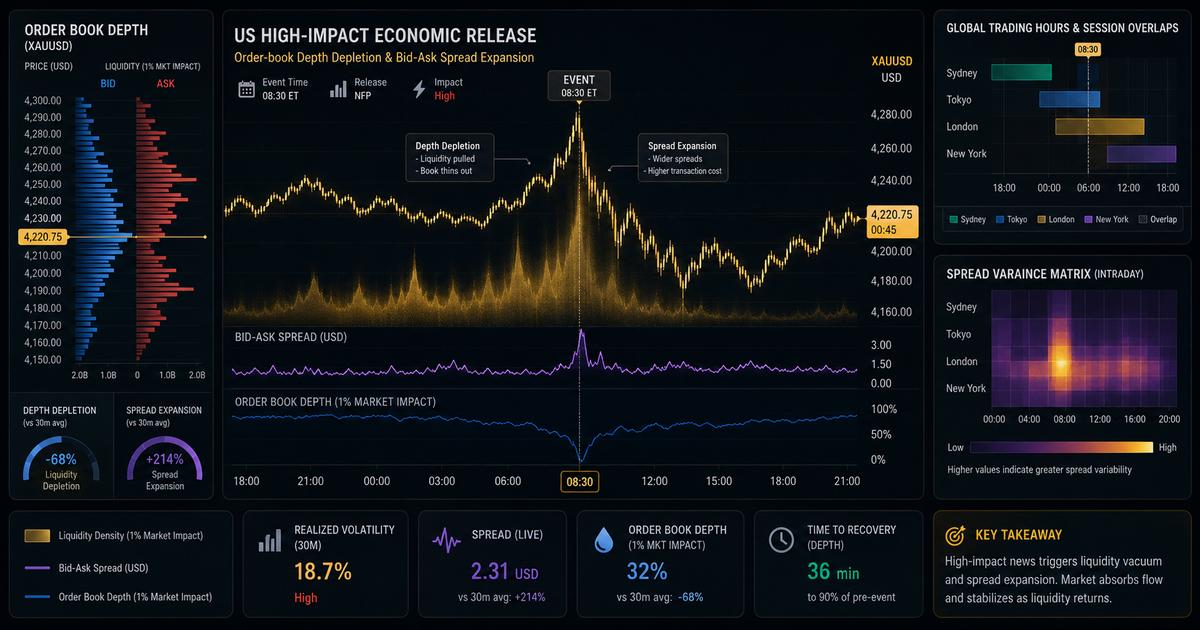
The Mechanics of News Volatility: The Phantom Liquidity Effect
Retail market participants frequently misinterpret rapid price extensions following an economic data print as a mere influx of massive trading volume. In reality, the initial structural velocity is primarily driven by a phenomenon known as Institutional Liquidity Thinning.
Seconds before the scheduled clock release of an NFP or CPI metric, Tier-1 interbank liquidity providers (such as major global bullion clearing desks) temporarily withdraw their resting limit orders from the book. They execute this step to insulate their operations from toxic adverse selection—the risk of being filled against high-frequency algorithms that process data packets ahead of human comprehension.
When these resting limit orders vanish, the electronic order book is transformed into a hollow space. With no resting bids or asks to cushion incoming transactions, even a standard market order can cause a massive price step jump. This structural gap creates the volatile gaps and immediate vertical spikes characteristic of major economic data releases.
Deconstructing the Primary Volatility Vectors
Not all macroeconomic data updates alter gold markets in the same manner. Systematic strategies must adjust parameter rules based on the specific historical risk vectors of each individual data report type:
1. Non-Farm Payrolls (NFP): The Employment Shockwave
The US labor report represents the foundational metric for economic expansion and terminal interest rate paths. Deviations between forecasted expectations and published realities spark massive repositioning across the US Dollar and Treasury yields. Because gold operates as a direct non-yielding monetary alternative, an NFP print below expectations creates a cascading rush into spot bullion, generating massive vertical momentum within fractions of a second.
2. Consumer Price Index (CPI): The Inflation Velocity Vector
In modern market regimes, inflation data acts as the ultimate catalyst for algorithmic capital distribution. CPI outcomes establish immediate pricing adjustments regarding Federal Reserve monetary policy vectors. If a CPI print exceeds expectations, systematic real yield algorithms aggressively sell gold instruments across all interbank hubs, triggering structural breakdown sequences.
High-Impact Economic Release Architecture
To properly prepare automated trading infrastructure for these systematic volatility inflection events, review the localized metric behavior index outlined below:
| Economic Indicator | Primary Macro Correlation | Order-Book State (T-0) | Algorithmic Risk Protocol |
|---|---|---|---|
| Non-Farm Payrolls (NFP) | USD Yield / Labor Health Linkage | Extreme Volume Nodes Evacuation | Deactivate Execution; Clear Active Trailing Targets |
| Consumer Price Index (CPI) | Real Interest Rate Forecast Shifting | Extreme Volatility Gap Generation | Enforce Maximum Slippage Protection Controls |
| FOMC Interest Rate Decision | Terminal Policy & Liquidity Conditions | Prolonged Bid-Ask Spread Widening | Full Systematic Pause; Reactivate 30 Min Post-Presser |
| Retail Sales Data | Consumer Spending Health Tracing | Moderate Order Depth Retained | Standard Operational Settings; Enforce Live Spread Tracking |
Slippage Anomalies: The Dark Side of Market Execution
When an algorithm or a manual operator routes a market order into an empty order book during an active CPI or NFP release, they invite severe structural risk. A market order does not guarantee a specific price; it guarantees immediate execution at whatever price is available in the matching queue.
If the visible chart price indicates gold is trading at $4,200.00, but all resting limit orders between $4,200.00 and $4,202.50 have been pulled by market makers, a buy market order will fill at $4,202.50. This variance is known as toxic slippage.
Slippage instantly degrades a strategy's long-term mathematical edge. If a position size is built under the assumption of a tight structural stop-loss, a news-driven slippage event can double or triple the intended risk allocation, leading to significant drawdowns or prop firm account breaches.
Systematic Mitigation: Calibrating Execution Filters
Protecting automated pipelines from data release shocks requires integrating time-based circuit breakers and technical data overlays. Modern systematic execution frameworks must prevent new positions from opening during periods of intense structural instability.
Before high-impact events occur, operators should cross-reference live metrics against structural account allocations. Utilizing tools like our Gold Position Size Calculator allows automated systems to scale lot allocations down to defensive baselines as raw market volatility expands.
Additionally, for proprietary fund traders managing capital under strict risk profiles, keeping drawdowns controlled during sudden macro-driven spread expansions is crucial. Monitoring live risk exposure via our professional Prop Firm Drawdown Calculator ensures that unexpected news-driven slippage does not cross the maximum trailing loss thresholds of your evaluation account.
Conclusion: Dominating Through Structural Patience
Macroeconomic news events do not need to be a source of random account drawdowns. By understanding the underlying mechanics of order-book thinning and institutional clearing behaviors, systematic operators can adjust their execution parameters defensively. Avoid chasing initial news reactions into thin order-book profiles. Let the macro shock normalize, allow Tier-1 market makers to restock their liquidity nodes, and then execute your edge with precision and confidence.
Macro Impact & News Trading FAQ
Why do spot gold spreads expand drastically seconds before an NFP or CPI release?
Seconds before high-impact macro data is published, Tier-1 institutional market makers withdraw their resting limit orders from the central clearing pool to avoid toxic adverse selection. This sudden removal of order-book depth creates an electronic liquidity void, forcing the bid-ask spread to expand exponentially until data normalization occurs.
What is the structural cause of severe trade slippage during news events?
Slippage occurs because market orders require an immediate matching counterparty. If your order hits the market during a news-driven liquidity void, there are no available shares or lots at your requested price level. The matching engine is forced to route your trade to the next available institutional quote, which may be dozens of pips away from the visible chart price.
How can systematic trading systems mitigate high-impact macro volatility risks?
Automated pipelines should integrate strict time-based circuit breakers alongside maximum spread-variance filters. Deactivating execution sequences 5 minutes prior to scheduled releases and maintaining a freeze until order book volume node density returns to normal parameters prevents toxic fills.