The acceleration of high-frequency data streaming across global capital networks has fundamentally altered the structural mechanics of modern proprietary trading. For retail operators utilizing corporate liquidity structures, high-impact macroeconomic announcements—such as US Consumer Price Index (CPI) sheets or Non-Farm Payroll (NFP) printings—represent highly dangerous environments. While the volatile swings offer massive near-term reward potential, proprietary risk engines heavily monitor these periods. Failing to audit specific server-side news execution boundaries remains one of the primary catalysts for sudden, automated evaluation account liquidation.
1. The Architecture of Prop Firm News Restrictions
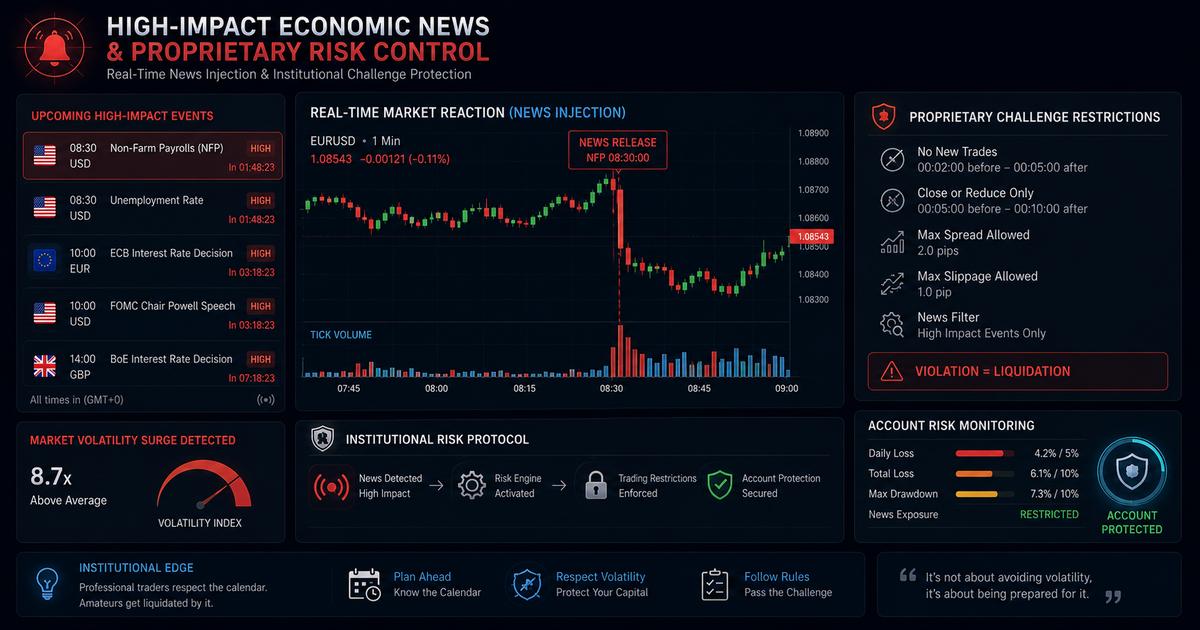
To protect their pooled tier-1 capital reserves from catastrophic tail-risk events, funding platforms categorize their modern capitalization models into highly specific rule matrices. A trader must recognize that funding firms do not execute trades on retail assumptions; they route orders through clearinghouses where sudden data gaps can cause severe systemic slippage.
Consequently, multiple classic account tiers explicitly prohibit active trade modification during high-impact market data releases. Understanding which environment governs your active capitalization layer dictates your real survival metrics.
2. Account Categorization: Strict Restrictions vs. News-Friendly Models
Proprietary funding challenges generally separate account models into two primary execution categories. Operating blindly without identifying your current model structure can lead to instantaneous compliance failures:
- Evaluation & Highly Restricted Tiers: Designed to test internal discipline, these accounts strictly ban executing or modifying orders within a designated window—frequently 2 minutes prior to and 2 minutes following high-impact economic calendar events. Breaking this rule leads to immediate asset closure, profit forfeiture, or account termination.
- Express / Advanced / Premium Tiers: These premium models typically permit news execution, but they pass the entire burden of market slippage directly to the operator, meaning bad fills can still easily trigger capital breaches.
When interbank liquidity drops during high-impact announcements, the spread between bid and ask pricing widens excessively. This structural gap directly threatens your daily loss boundary. For a complete blueprint on the math behind this real-time risk calculation, study our deep-dive pillar guide on The Science of Daily Drawdown: How to Never Breach Prop Firm Rules.
| Account Type | News Execution Status | Underlying Risk Engine Impact |
|---|---|---|
| Standard Evaluation Tiers | Strictly Prohibited (±2 Min Window) | Automated hard liquidation upon execution flag. |
| Premium / No-Restriction Models | Explicitly Permitted | Full exposure to raw interbank slippage and gaps. |
| Funded Master Class Allocations | Varies (Profits restricted on news) | Trailing stops lock artificially at peak equity points. |
3. The Mechanics of Market Slippage and Order Vacuums
The core hazard of trading during high-impact releases stems from a sudden drop in interbank liquidity. Institutional market makers completely pull their limit orders from the electronic communication networks (ECNs) milliseconds before a data point hits the wires. This creates a temporary asset vacuum.
If your trade setup triggers an order or hits a protective stop-loss within this vacuum, your broker cannot execute the order at your exact specified price. Instead, the trade slips to the next available market quote, which can be significantly worse than intended. This variance can completely bypass your risk parameters and breach your daily drawdown limit before the server can register a defensive exit.
4. Algorithmic Avoidance: How to Prevent News-Induced Liquidations
Surviving macroeconomic events with your corporate funding allocation intact requires moving away from manual tracking toward systematic execution routines. Implement these three procedural protocols to ensure total safety:
- Automate Calendar Syncing: Integrate centralized API feeds or automated alarm structures that actively sync global macroeconomic tracking modules directly to your local workstation.
- Hard Stop Execution Curfews: Establish a rigid operational rule to freeze all active market entry modifications exactly 15 minutes before any tier-1 data release. Give the market sufficient time to clear existing order matching pools.
- Deploy News-Agnostic Core EAs: If you utilize algorithmic trading systems or automated Expert Advisors (EAs) in MQL5, ensure they feature built-in news filter modules to automatically halt trade entry sequences before major economic announcements.
5. Recovering Capital Integrity After Market Volatility
If a sudden, high-volatility event slips through your defenses and impacts your capital allocation balance, do not attempt to aggressively trade your way back out of the drawdown. Doing so under highly volatile market conditions typically compounds your losses and accelerates automated server liquidation sequence flags.
Instead, immediately transition your strategy into a structural capital recovery phase. Systematically map out your remaining capital buffers and calculate your adjusted lot parameters using our specialized Trading Drawdown Recovery Guide. This approach ensures you rebuild your balance using consistent, mathematically sound position sizes.
Eliminating Human Latency via Algorithmic Sizing Components
Do not rely on mental math or manual calculations when major economic updates are hitting the wire. To protect your funded account allocation, process your risk metrics through our dedicated analytical tools.
By utilizing our automated position calculators, you can dynamically adjust your lot allocations based on real-time asset volatility, keeping your strategy safely insulated from sudden market movements.
Conclusion: Strategic Operational Control Isolates Profit Curves
Earning consistent payouts from proprietary trading platforms requires a deep respect for server-side execution rules and market realities. High-impact macroeconomic events are not times for reckless gambling; they require highly disciplined, systematic risk management. By accurately auditing your account's news trading rules, stepping aside during liquidity drops, and calculating your real-time risk boundaries, you protect your trading capital and ensure long-term consistency.
Prop Firm News Trading Rules FAQ
What exactly triggers a news restriction breach on an evaluation account?
Proprietary evaluation clearing houses deploy algorithmic scripts that audit execution timestamps. Opening, closing, or modifying pending limit layers within a strict restricted window (typically 2 minutes prior to and following a high-impact calendar release) triggers an automated hard or soft platform violation flag.
How does market slippage during high-impact data events impact daily drawdown constraints?
During tier-1 events like CPI or NFP, interbank liquidity dries up instantly. If a stop-loss is triggered within these order vacuums, the clearing server executes the liquidation at the next available market quote, far worse than the designated parameters. This extreme divergence can instantly breach a portfolio's strict maximum daily loss ceiling.
Can an automated script or expert advisor (EA) bypass macroeconomic event restrictions?
No. Unless an operator utilizes a specific premium account model that explicitly allows high-impact event execution, automated expert advisors will still have their execution timestamps audited by server-side risk engines. Algorithmic scripts should be explicitly programmed to pause operational cycles during macroeconomic releases.