Albert Einstein famously declared compound interest to be the eighth wonder of the world. In the digital financial arenas, however, this geometric mechanism is frequently ignored in favor of destructive, over-leveraged get-rich-quick strategies.
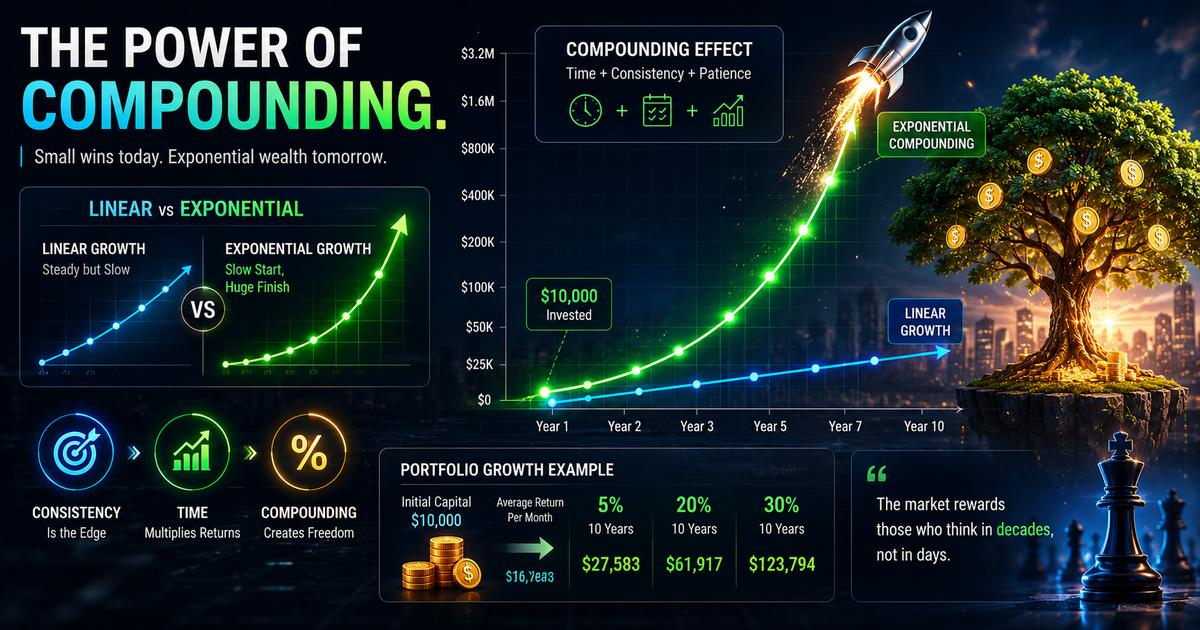
The Psychology of the Curve: Escaping the Instant Gratification Trap
The retail trading landscape is saturated with marketing narratives promising immediate wealth through high-frequency execution and extreme leverage settings. These get-rich-quick approaches exploit common cognitive blind spots, encouraging market participants to chase outsized returns on individual positions. In doing so, traders routinely commit excessive capital percentages to volatile market environments, turning structured speculation into an unsustainable game of chance.
Professional portfolio management relies on a fundamentally different principle: the mathematical certainty of geometric compounding. True wealth accumulation in capital markets does not depend on hitting rare, massive trade payouts. Instead, it is built on securing small, consistent gains while strictly managing drawdowns over hundreds of successive execution sessions.
To maintain perspective during this long-term growth process, understanding your exact downside limitations remains paramount. Developing a professional risk framework requires a clear mastery of position variables. For a deep look at stabilizing your capital framework, reviewing our analysis on the 5 Essential Risk Management Strategies provides the precise foundation needed to transition from gambling to structured consistency.
Deconstructing Geometric Growth: The Pure Mathematics
To understand why compounding outpaces aggressive linear trading, we must evaluate the underlying mathematics. Linear growth occurs when a trader withdraws fixed cash amounts or maintains uniform lot sizes regardless of total account equity. For example, generating a static $500 payout every month on a $10,000 account balance yields a linear trajectory—predictable, but structurally capped.
Geometric compounding occurs when profits are retained within your capital base, allowing successive trade volumes to scale proportionally with your expanding equity baseline. The equation driving this exponential progression is calculated as follows:
Future Capital Value = Initial Principal × (1 + Periodic Rate of Return)^Number of Periods
This relationship completely transforms how risk is managed. Instead of adjusting leverage upward to increase returns, a trader allows the expanding asset base to scale total transaction values naturally. This structural change ensures that your overall market exposure remains conservative relative to your account size, while your absolute dollar returns expand exponentially over time.
A Clear View: Linear Return Streams vs. Exponential Compounding
Let us look at a realistic mathematical example to see how compounding transforms capital over time. Suppose two separate accounts begin with an identical $5,000.00 USD initial deposit. Both trading systems achieve a consistent average return of 5% per month over a total timeframe of 36 months.
- The Linear Account: This trader withdraws exactly 5% ($250.00) at the end of every month. The capital base stays locked at $5,000.00, resulting in total profits of $9,000.00 over 36 months, keeping the final account value at $5,000.00.
- The Compounding Account: This trader retains all earnings within the account balance. Each successive month's 5% return is calculated based on the new, larger equity pool, allowing position sizes to scale smoothly and automatically.
| Timeline Milestones | Linear Account Value (With Regular Withdrawals) | Compounding Account Value (Profits Retained) |
|---|---|---|
| Month 00 (Initial Deposit) | $5,000.00 USD | $5,000.00 USD |
| Month 06 Milestone | $5,000.00 USD (+ $1,500 Withdrawals) | $6,700.48 USD |
| Month 12 (Year 1 Finish) | $5,000.00 USD (+ $3,000 Withdrawals) | $8,979.28 USD |
| Month 24 (Year 2 Finish) | $5,000.00 USD (+ $6,000 Withdrawals) | $16,125.50 USD |
| Month 36 (Year 3 Cumulative) | $5,000.00 USD (+ $9,000 Total Cash) | $28,959.26 USD |
Reviewing this data highlights a powerful realization: during the first 12 months, the difference between the two accounts seems minor. The linear trader enjoys regular cash payouts, while the compounding curve builds slowly. This slow initial phase is where many unprincipled participants lose patience, abandon their strategies, and fall back into high-risk habits.
However, as the asset base scales past month 24, the mathematical velocity of geometric compounding becomes undeniable. By month 36, the compounding account has grown to a substantial $28,959.26 USD without requiring higher leverage or risk percentages.
The Drag of Drawdowns: The Asymmetric Math of Trading Loss
While the math behind compounding charts can look exciting, maintaining this trajectory requires understanding the destructive impact of trading drawdowns. Geometric growth works both ways: just as profits compound exponentially, consecutive losses degrade your capital base asymmetrically, stalling your growth momentum.
Because your remaining account balance shrinks after a loss, the percentage gain required to return to break-even increases exponentially. For instance, experiencing a 20% decline requires a 25% recovery gain just to restore your initial capital position. If a trader allows their account to slide into a deep 50% drawdown, they face the monumental challenge of generating a 100% return simply to get back to zero.
This asymmetric recovery hurdle is why managing risk parameters carefully is critical to long-term survival. When you allow your margin levels to drop significantly, you expose your account to forced liquidation risks. To see exactly how sudden margin failures can disrupt your strategy, reviewing our guide on Understanding Margin Calls and Stop-Outs highlights why avoiding major drawdown cycles is essential to sustaining your compounding momentum.
Practical Strategies for Professional Portfolio Growth
Turning compounding theory into a consistent trading plan requires moving away from emotional decision-making. Professional portfolio systems use structured rules to keep capital growing safely:
- Implement Fixed-Percentage Position Sizing: Never risk more than 1% to 2% of your total account equity on any single trade setup. This protective baseline ensures that even an extended losing streak will not cause a drawdown that is mathematically difficult to recover from.
- Automate Account Sizing Updates: Re-calculate your trade lot allocations at regular intervals—such as weekly or monthly—using your updated equity baseline. This structured scaling ensure your positions expand naturally during winning cycles and contract automatically during drawdown periods.
- Prioritize Account Longevity Over Speed: Focus entirely on perfecting your execution consistency and keeping loss metrics tight. Let the mathematical mechanics of geometric compounding handle the long-term wealth expansion, keeping your account safe from high-risk trading traps.
Ultimately, professional trading functions like a specialized engineering discipline rather than a quick speculative path. By keeping position profiles aligned with your actual capital base and verifying mathematical requirements beforehand, you transform compounding from an abstract concept into a powerful tool for sustainable market success.
Compounding & Growth FAQ
How does compound interest mathematically apply to active trading accounts?
Compounding operates dynamically in trading by scaling contract lot sizes proportionally with your growing account equity. Instead of withdrawing standardized cash returns, profits are retained within the balance to expand total transaction capacity for successive positions.
Why do most retail traders fail to achieve the benefits of geometric compounding curves?
The primary barrier is psychological indiscipline and operational inconsistency. A single catastrophic, high-leverage drawdown can wipe out months of geometric gains. Retaining a steady compounding sequence requires avoiding over-leveraged risk exposures.
Should my trade lot sizes remain fixed during a professional compounding plan?
No. Fixed lot configurations result in linear growth. True compounding requires dynamic position sizing, where your total market exposure scales fluidly as a fixed risk percentage of your expanding account equity baseline.
How do drawdown cycles impact the overarching mathematical compound velocity?
Drawdowns act as an immediate break on geometric growth curves. Because recovery requires a higher percentage gain relative to the remaining capital base, consecutive losses flatten the compounding trajectory and delay long-term exponential acceleration.
Is it practical to compound account balances continuously within prop firm configurations?
Yes, but with strict adjustments. Prop firms enforce rigid daily and maximum loss rules. Traders can compound capital limits during evaluation phases, but must prioritize strict risk boundaries over aggressive lot scaling.