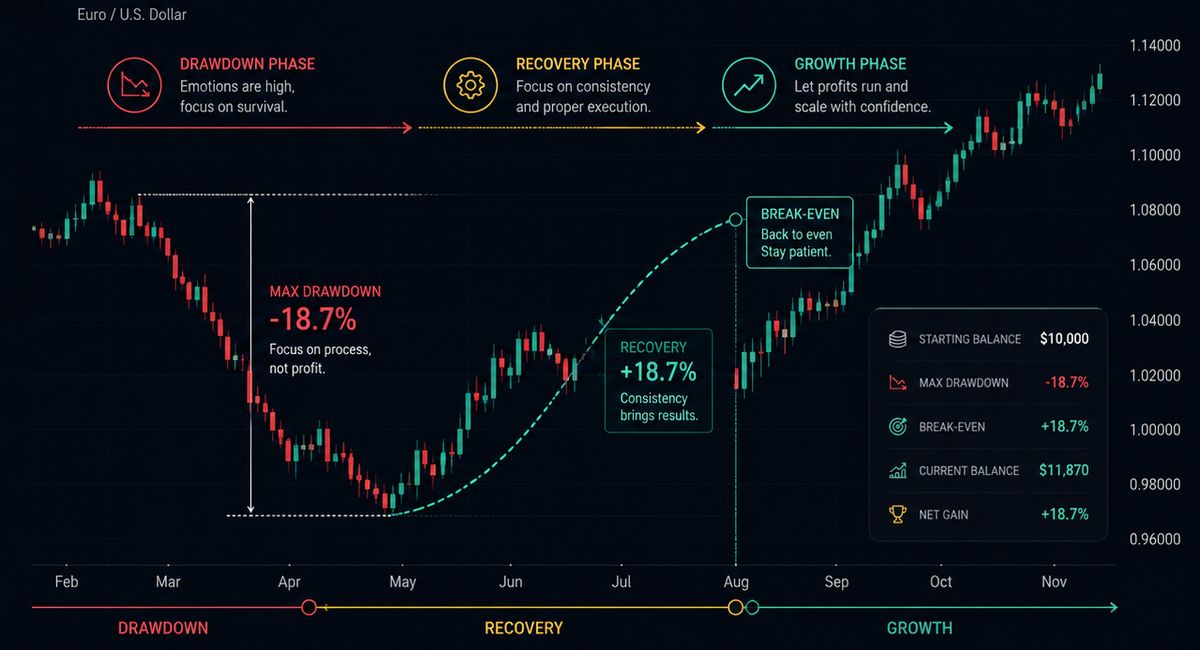
Every trader, from Wall Street veterans to retail beginners, faces the same inevitable enemy: Drawdown. It’s not a matter of "if" it will happen, but "when." The difference between those who go bust and those who become wealthy is how they handle the recovery.
Understanding the Brutal Math of Drawdown
Before you can recover, you must understand why drawdown is so dangerous. The math of trading is asymmetrical—losing money is much easier than making it back. This is known as the Recovery Percentage Gap.
| Drawdown (%) | Recovery Needed to Break Even (%) |
|---|---|
| 10% | 11.1% |
| 25% | 33.3% |
| 50% | 100% |
| 75% | 300% |
As shown above, once you lose 50% of your capital, you must double your money (100% gain) just to get back to zero. This is why capital preservation is the only way to play the long game. You can plan to recover your current drawdown with this Drawdown & Recovery Tool.
1. Stop the Bleeding: The Absolute Daily Limit
The first step in any recovery plan is to stop digging the hole. You need a Hard Stop. For most professional traders, this is a Maximum Daily Drawdown (often 2-3%) or a Maximum Monthly Drawdown (often 5-10%).
When you hit this limit, you must have the discipline to walk away. The market will be there tomorrow. Your capital might not be if you stay and trade with emotions.
2. Re-evaluate Your Edge (Market Condition Check)
Is your drawdown caused by poor discipline, or has the market shifted? Trends end, and ranges begin. If your Trend Following System is in a drawdown during a Sideways Market, the problem isn't you—it's the context.
Stop trading until you see your specific A+ Setup again. Professional recovery isn't about trading more; it's about trading higher quality.
3. The "Lower Leverage" Strategy
The most common mistake traders make during a drawdown is increasing their lot size to "make it back fast." This is Gambler's Fallacy.
Instead, you should do the opposite: Cut your risk in half. If you usually risk 1%, risk 0.5%. Your goal during recovery isn't to get rich; it's to get your confidence back through small, consistent wins.
4. Psychological Resilience: The Reset Button
Drawdown creates a "scarcity mindset." You start fearing every trade. To fix this, you must separate your Self-Worth from your Net Worth.
Take a 3-day break. Completely. No charts, no Twitter, no GBP/USD. Reconnect with the real world. When you return, treat your current account balance as your "New Day 1." Forget what you lost; focus only on what you have now.
5. Use Professional Recovery Tools
Don't guess your way out of a hole. Use data. Track your Equity Curve. If your curve is sloping down sharply, your system is broken or the risk is too high.
Before you can recover, you must stabilize your account by revisiting the 5 Essential Risk Management Strategies every trader should follow.
Recovery often requires patience and selecting the right assets. Learn the mechanics of trending markets in our Crude Oil Trading Mastery guide.
Drawdown Recovery FAQ
How long does a typical recovery take?
It depends on your risk-to-reward ratio. Typically, a safe recovery from a 10% drawdown takes 2-4 months of disciplined trading.
Should I change my strategy in a drawdown?
Never change a proven system in the heat of a drawdown. Refine your execution and risk management first.