In the institutional landscape of professional asset management, leverage is recognized as a two-sided structural multiplier. While high leverage coefficients increase purchasing power, they simultaneously accelerate capital variance if market volume is unmanaged. To prevent mathematical degradation, retail traders must shift from arbitrary volume inputs to an exact understanding of contract configurations. The ability to smoothly transition between Standard Lots, Mini Lots, and Micro Lots acts as an operator's primary mechanism for tuning exposure and engineering robust risk protocols.
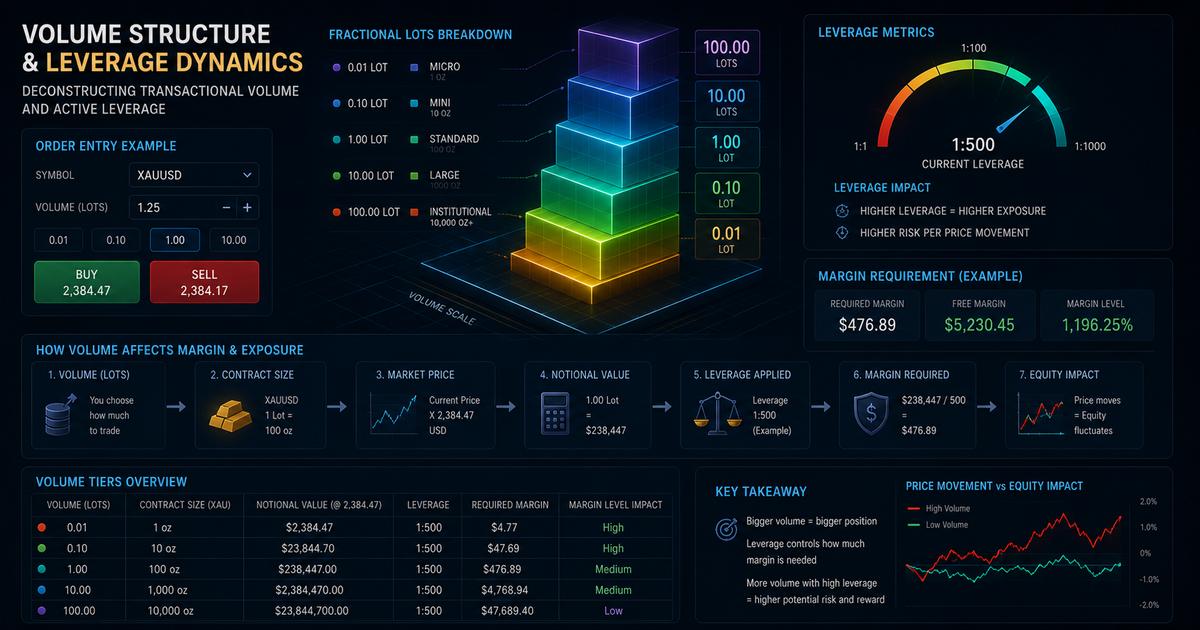
The Lot Hierarchy: Contract Size Dissection
To calculate real-world risk, an operator must look under the interface of commercial trading terminals. A "Lot" is simply a standardized container holding a specific volume of an asset. In foreign exchange instruments, these containers are broken down into three distinct, linear tiers:
- The Standard Lot (1.00 Volume): Controls exactly 100,000 units of the base currency. This is the institutional benchmark block size.
- The Mini Lot (0.10 Volume): Controls exactly 10,000 units of the base currency. It represents a 10% structural downscale.
- The Micro Lot (0.01 Volume): Controls exactly 1,000 units of the base currency. This provides the ultimate layer of risk granularity.
When you execute position sizes across highly volatile spots or currency crosses, your selected contract container directly dictates your capital variance per point. Without establishing these mathematical foundations, dynamic leverage parameters will quickly work against your trading path. To fully master the mathematical distribution models required to absorb this volatility, read our comprehensive centerpiece analysis on The Mathematics of Position Sizing: Managing Risk in High-Volatility FX and Gold Markets.
The Mathematics of Margin and Leverage Activation
Selecting a specific lot volume container doesn’t merely alter the price-per-pip value; it mathematically restructures your broker account's Required Margin. Required margin is the capital insurance block your broker locks down to sustain an active market order.
The quantitative formula that dictates how contract configurations resolve into required margin is structured as follows:
Let’s look at a concrete operational scenario. Imagine executing an entry on EURUSD at a spot price of 1.1000 using an account configured with 1:100 broker leverage:
1. Standard Lot Execution (1.00 Lot)
Executing a single standard lot requires your broker to secure a substantial asset pool from your free equity.
Margin Calculation = (1.00 × 100,000 × 1.1000) / 100
Required Margin = $1,100.00 USD
2. Mini Lot Execution (0.10 Lot)
Scaling the position container down to a mini tier drops the overall market liability by exactly 90%.
Margin Calculation = (0.10 × 100,000 × 1.1000) / 100
Required Margin = $110.00 USD
3. Micro Lot Execution (0.01 Lot)
The micro container level provides maximum defense for under-capitalized balances or precise scaling models.
Margin Calculation = (0.01 × 100,000 × 1.1000) / 100
Required Margin = $11.00 USD
| Lot Type Metric | Terminal Volume Input | Nominal Exposure (EURUSD @ 1.10) | Margin Cost (1:100 Leverage) |
|---|---|---|---|
| Standard Lot | 1.00 | $110,000 USD | $1,100.00 USD |
| Mini Lot | 0.10 | $11,000 USD | $110.00 USD |
| Micro Lot | 0.01 | $1,100 USD | $11.00 USD |
Real vs. Nominal Leverage: The Retail Illusion
Many retail participants believe that operating an account with a high leverage ratio (like 1:500) automatically makes their positions riskier. This is a common mathematical misunderstanding.
Your account's maximum leverage ratio simply dictates the lower boundary of required margin your broker enforces. What truly determines your portfolio variance is your Real Leverage Usage, which is governed entirely by your choice of lot sizes. If you hold a $10,000 account and execute a single Standard Lot (1.00) of a major pair, your nominal market exposure is $100,000. In this scenario, your real leverage usage is exactly 10x your actual account capital, regardless of whether your broker permits 1:100 or 1:500 access.
By dropping your volume scale down to a Micro Lot (0.01 lot = $1,000 nominal exposure), your real leverage allocation falls to 0.1x your actual capital. This allows you to smoothly absorb wide market swings without triggering margin distress.
Simulate Real Margin Demands
Input your active terminal lot targets below to map out exact contract distributions and clear allocation boundaries before risking equity.
Forex Position Size Calculator
Amount at Risk: $0.00
Enforcing Strict Portfolio Allocation Controls
To maintain structural discipline and avoid catastrophic margin call cascades, you must integrate three operational protocols into your daily execution routines:
- The Volatility Inverse Rule: Always scale down your lot container level (e.g., from Standard to Mini/Micro) when moving from low-ATR currency pairs into extreme high-range structures like Gold.
- Margin Buffer Engineering: Ensure your aggregate required margin across all active market orders never consumes more than 5% to 10% of total available account equity.
- Granular Position Layering: Utilize micro-lot allocations to scale into position blocks systematically, optimizing your average execution price without oversaturating your risk ceiling.
Conclusion: Mathematical Mastery Beats Luck
The pricing engine of global financial markets does not account for a trader's hope or intuition. It operates purely on volume distribution matrices and structural mechanics. Transitioning away from blunt, static lot selections and mastering fractional lot scaling gives you complete command over your portfolio's real leverage usage. This mechanical control forms the foundation of long-term consistency, keeping your capital insulated while positive probabilistic outcomes unfold over time.
Lot Scaling & Leverage FAQ
What is the unit size difference between a Standard, Mini, and Micro lot in Forex?
A Standard lot represents 100,000 units of the base currency (1.00 lot). A Mini lot represents 10,000 units (0.10 lot), and a Micro lot represents 1,000 units (0.01 lot). Scaling down allows retail operators to fine-tune risk metrics.
How does choosing a Micro lot affect my account leverage?
Choosing a Micro lot does not alter the broker's leverage ratio itself, but it dramatically lowers your absolute financial exposure and dynamic leverage usage. This allows you to trade high-volatility setups with smaller account balances without over-leveraging.
How do you calculate required margin based on lot selection?
Required Margin = (Lot Size × Contract Size) / Leverage. Because contract sizes scale down linearly from Standard (100k) to Micro (1k), your required margin drops proportionally, drastically freeing up usable equity.