In the high-stakes world of global finance, your transaction volume matters infinitely more than your market entry point. Proper allocation is the ultimate mathematical proof that saves accounts from blowing up.
The Brutal Reality of Probability and the "Sequence of Returns"
Human psychology is inherently flawed when interpreting probability. When traders deploy a system with a verified 60% win rate, they naturally assume that out of every 10 trades, they will win 6 and lose 4 in a neatly distributed order. In live markets, however, randomness manifests as the Sequence of Returns—the unpredictable stringing together of consecutive outcomes.
Even with a mathematically sound 60% win rate tested across thousands of samples, probability dictates that it is statistically inevitable to encounter a streak of 6 to 8 consecutive losses at some point in your career.
Consider two traders using the exact same technical setups. Trader A overtrades, risking 15% of their account per trade due to extreme confidence in a breakout. When hit by a completely normal 6-trade losing streak, their account suffers a devastating 90% drawdown, making recovery mathematically impossible. Conversely, Trader B utilizes strict position sizing to cap risk at exactly 1% to 2% per trade. After the exact same losing streak, their capital is down by only 6% to 12%, a minor drawdown easily recovered within a few winning setups.
The Asymmetry of Drawdown: A Mathematically Non-Linear Trap
The absolute necessity of preventing deep account drawdowns lies in the non-linear mathematics of financial loss. Capital recovery is asymmetrical; as your account capital declines, the percentage gain required to simply return to your original breakeven point increases exponentially.
If you let your account drop by 50%, you must generate a 100% return on your remaining capital just to get back to where you started. Achieving a 100% gain requires massive risk exposure, which almost always results in a complete margin call. Therefore, dynamic position sizing acts as your primary shield, preventing you from ever entering this mathematical death spiral.
💡 Deep Dive: If you are already caught in a deep equity decline and want to see the step-by-step mathematical blueprint to rescue your portfolio, check out our companion guide on The Math of Drawdown Recovery: How to Bounce Back From Financial Loss.
The Standard Lot Size Formula Used by Institutional Traders
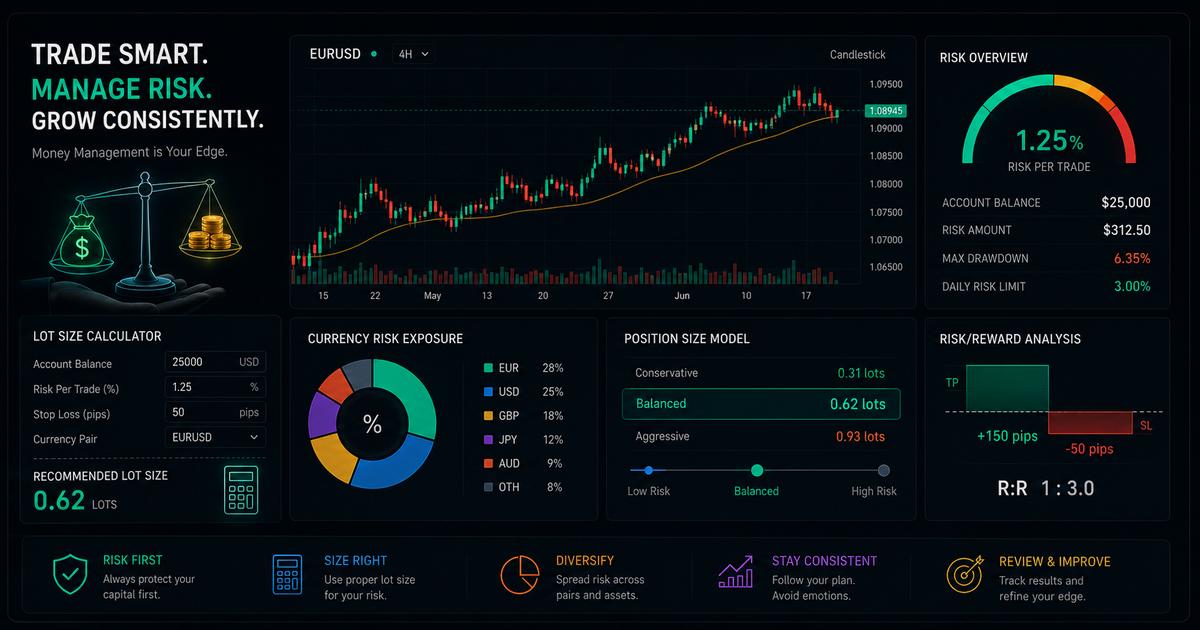
Professional risk management completely discards emotional guesswork or arbitrary lot sizing (e.g., arbitrarily opening 0.1 or 1.0 lots). Instead, institutional allocation relies on a strict mathematical formula:
// Professional Lot Size Equation
Lot Size = (Account Balance × Risk %) / (Stop Loss in Pips × Pip Value)To execute this formula flawlessly, you must define four core variables:
- Account Balance: The total available equity currently held within your account (e.g., $10,000).
- Risk Percentage: The maximum monetary loss you are willing to tolerate on a single trade (Industry standard suggests 1% to 2%).
- Stop Loss (Pips): The absolute structural validation distance on your chart, derived from technical market structure—never an arbitrary fixed number.
- Pip Value: The monetary value per pip relative to your account currency, which dynamically alters based on the currency cross or commodity type (e.g., EURUSD vs. XAUUSD vs. Crude Oil). You can find the exact pip value for your trading asset using our Pip Value Calculator.
You can use our calculator for Forex Position Size or Gold Position Size or Oil Position Size to get it right on your assets every time.
Next Step for Professional Traders
Once you master the mathematics of lot sizing, the next step is validating your strategy against years of historical data to discover its true win rate.
Read Our Comprehensive Guide: Why Backtesting is the Trader's Ultimate Edge →The Fatal Fallacy: Fixed Lots vs. Fixed Fractional Risk
A vast majority of retail participants default to a Fixed Lot model, executing exactly 0.05 lots on every single setup regardless of asset or invalidation parameters. While this approach feels structured, it introduces two catastrophic structural vulnerabilities:
First, it causes Asymmetrical Monetary Risk. If Trade A requires a tight structural Stop Loss of 20 pips, and Trade B requires a broader macro invalidation of 60 pips, executing identical lot allocations means Trade B exposes you to three times the financial risk of Trade A without any statistical justification.
Second, it completely Ignores Asset Volatility. Trading Spot Gold (XAUUSD) possesses an entirely different average true range (ATR) compared to standard currency pairs like EURUSD. Deploying generic fixed lots across disparate instruments guarantees oversized losses when entering highly volatile commodity expansions. Elite proprietary firms and hedge funds globally eliminate this flaw by using a Fixed Fractional Risk matrix—adapting transaction volumes dynamically to ensure the absolute dollar amount lost remains uniform on every setup.
Conclusion: The Universal Law of Longevity
Market mathematician and trading pioneer Larry Williams famously remarked: "Money management is the true mechanism that converts a standard technical pattern into a hyper-efficient cash generation engine."
Shift your attention away from chasing elusive 100% win-rate methodologies. Instead, master the underlying financial mathematics of your portfolio. When your risk exposure is mathematically predictable, execution anxiety and emotional greed evaporate. You gain the cognitive peace of knowing that even under worst-case market anomalies, a single failed setup will never compromise more than 1% of your equity.
Cultivate professional habits by calculating your precise position size before sending any execution commands to your broker. Your long-term career curves will thank you.
Position Sizing FAQ
What is the standard rule for position sizing risk?
Professional risk management models universally suggest risking between 1% and 2% of total account equity on any single trading setup. This keeps drawdowns completely manageable.
Why is fixed lot size dangerous in volatile markets?
Fixed lot sizing ignores varied stop-loss distances and specific asset volatility. For instance, trading Gold (XAUUSD) with the same lot size as EURUSD exposes you to asymmetrical monetary risk due to Gold's high average true range.
How does account drawdown affect recovery math?
Account drawdown is mathematically non-linear. Losing 10% requires an 11.1% gain to recover, but losing 50% requires a massive 100% gain on remaining capital just to reach break-even.