The modern prop firm industry has democratized access to capital, allowing talented traders to manage six-figure accounts. But the gap between "buying a challenge" and "getting paid" is bridged by only 5% of participants. This guide isn't about hope—it's about the cold, hard math of passing.
1. Understanding the Adversary: The Rules of the Game
Before discussing how to win, you must understand how you lose. Most modern firms (such as FTMO, FundedNext, or The5ers) operate on two primary constraints: the Maximum Daily Loss (usually 5%) and the Maximum Overall Drawdown (usually 10-12%).
The "Daily Loss" is the silent killer. It is typically calculated based on your starting balance or equity at 00:00 server time. Even if you are in a profitable month, a single day of emotional volatility can terminate your account instantly.
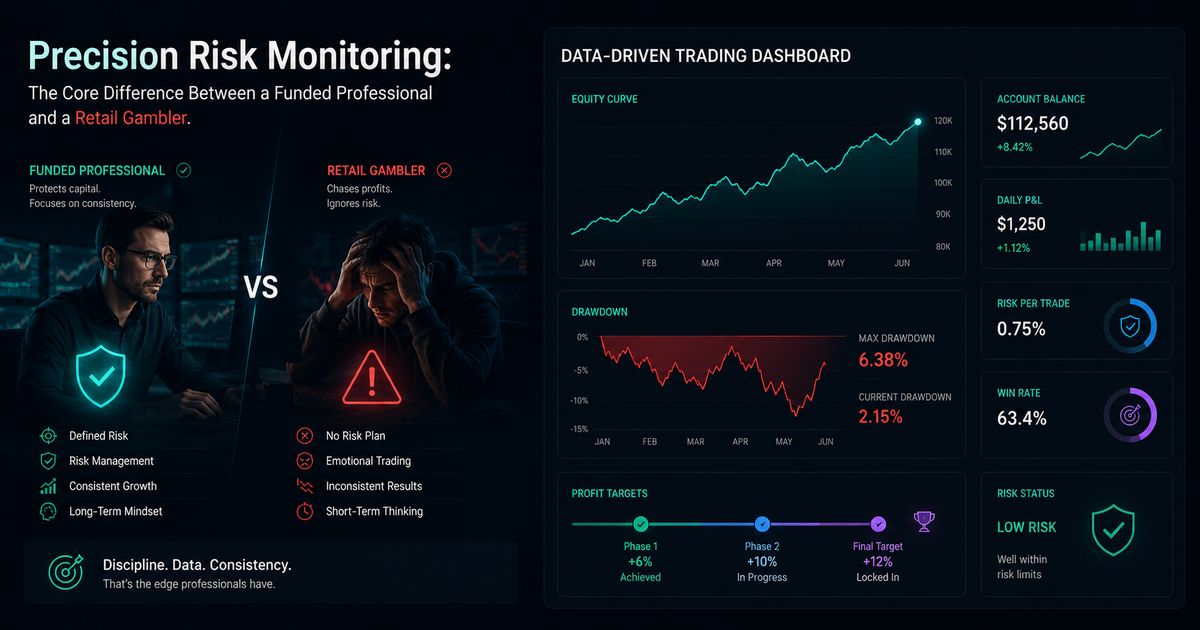
2. How to Pass: The Step-by-Step Execution Plan
Passing a challenge requires a shift in mindset from "Profit Seeking" to "Risk Preserving." Here is the professional roadmap:
Phase A: The Foundation (0% to 3% Profit)
This is the most dangerous stage. Your "buffer" is zero. During this phase, you should risk no more than 0.25% to 0.5% of your balance per trade. The goal isn't to hit the target; it's to build a "risk cushion." Once you are up 2-3%, you are now trading with the firm's money, not your account's life.
Phase B: The Acceleration (3% to 7% Profit)
With a 3% cushion, you can slightly increase your risk to 0.75% or 1% per trade. This allows you to capitalize on high-probability setups to reach the target faster. However, if your balance drops back to the starting point, you must immediately revert to Phase A risk levels.
Phase C: The Closing (7% to 10% Profit)
Many traders fail here because they get "profit greed." As you approach the target, de-risk. Use smaller lot sizes to crawl across the finish line. One big loss at 9% profit is a psychological trauma that leads to revenge trading.
3. The Mathematical Edge: Position Sizing
If you are guessing your lot size, you have already failed. A $100,000 account doesn't mean you can trade 10 lots of Gold. Depending on your stop loss, 10 lots could breach your daily 5% limit ($5,000) in seconds.
The Formula for Survival: Always calculate your lot size based on your Daily Drawdown Remaining. If you've already lost 2% today, your remaining daily risk is only 3%. Your next trade's risk should be a fraction of that 3%, not the original 100k balance.
The "ProfitFlow" Passing Hack
Treat the 5% Daily Drawdown as your True Balance. If you have a $100,000 account, you don't have $100,000 to trade — you have $5,000. Risking 1% of $5,000 ($50) per trade is much more sustainable than risking 1% of $100,000 ($1,000).4. Psychological Warfare: Avoiding the Breach
Prop firms profit from your impatience. They set time limits (though many are moving to "no time limit" models) to induce stress. To counter this:
- Walk Away After 2 Losses: If you hit two consecutive stop losses, your brain enters a "fight or flight" mode. Close the terminal. The market will be there tomorrow.
- Ignore the "Leaderboards": Seeing others pass in 2 days creates a false sense of urgency. Your only competition is the drawdown meter.
- Audit Your Spreads: Many firms widen spreads during news. If you trade during news, you risk a "hidden drawdown" breach.
5. Post-Pass: The Funded Phase
Passing the challenge is only the beginning. Once funded, the goal is the First Payout. Statistics show that most traders blow their funded account within the first 30 days. To avoid this, keep your risk at Phase A levels (0.5% max) until you secure your first withdrawal.
Even the best traders face setbacks. Knowing how to recover from a trading drawdown without losing your account is a critical skill for any funded trader.
Success in any prop firm ultimately boils down to a single factor: your defensive play. Revisit our 5 Essential Risk Management Strategies to solidify your trading foundation.
Expert FAQ: Prop Firm Strategy
How do I calculate my maximum lot size for a Prop Firm challenge?
Calculate your lot size based on your Daily Drawdown limit, not your total account balance. If your daily limit is 5%, treat that as your 'functional capital' and risk only 0.25% to 0.5% of the total balance per trade.
Is it better to trade high or low volatility assets during a challenge?
Low to medium volatility assets (like EURUSD or GBPUSD) are often safer for passing challenges because they reduce the risk of massive slippage that could breach a strict daily drawdown rule.
What is the most common reason for failing a funded account?
The leading cause is "Revenge Trading" after a minor loss, leading to a breach of the daily equity drawdown limit — a rule enforced by almost all major prop firms.
Which prop firm has the easiest rules?
There is no "easiest" firm, but look for those with Relative Drawdown versus Static Drawdown. Static drawdown is generally more favorable for the trader as it doesn't move up with your balance.
Should I use an EA to pass my challenge?
EAs can help with discipline, but ensure the firm allows "Algorithmic Trading." Many firms have strict rules against HFT (High-Frequency Trading) or Grid bots.